Section 4.2 - The Jurat
The second form most frequently completed by a notary public is the jurat. (Government Code section 8202) The jurat is identified by the wording "Subscribed and sworn to (or affirmed)" contained in the form and must be completed by the notary after a number of other steps are followed.
The primary purpose of a jurat is to compel truthfulness in a signer. By executing a jurat, the notary public is certifying that:
The signer personally appeared before the notary public on the date indicated and in the county indicated.
The signer signed the document in the presence of the notary public.
The notary public administered the oath or affirmation.*
The notary public verified the identity of the signer.
The jurat must be attached to all affidavits subscribed and sworn to before the notary public. An affidavit is a written statement of facts made voluntarily and confirmed by the oath or affirmation of the party making it before an officer authorized to administer oaths (i.e., the notary public).
Subscribed simply means signed; the subscriber is the signer of a document or the party requesting notarization. Sworn to or affirmed is the verbal or spoken component of the act - the oral declaration made by the subscriber that statements contained in the document are true. The jurat is the notary's written verification or proof of the preceding events. Any jurat taken within the State of California shall be in the following form:
NOTE: Key wording of a jurat is "subscribed and sworn to (or affirmed) before me." It is not acceptable to affix a jurat to a document mailed or otherwise delivered to a notary public whereby the signer did NOT personally appear, take an oath, and sign in the presence of the notary public. Also, it is not acceptable to affix a notary public seal and signature to a document without the notarial wording.
Oaths, Affirmations and Terminology
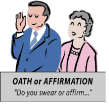 Oath, affirmation, jurat, verification, attestation, certification, and affidavit. These words are often used loosely and interchangeably in the context of a jurat. Some of these terms are synonymous; others may have the same effect in practice, but a slightly different meaning. An oath, for example, is a statement made by the party requesting notarization attesting to truthfulness which binds them in conscience to a Supreme Being. Because this is not appropriate for all people, affirmations are also used, which have the same effect in practice. Appendix A contains more concise definitions of these terms.
Certain Documents Containing Statements Related to Age
According to Section 8230 of the Government Code, if a notary public executes a jurat and the statement sworn or subscribed to is contained in a document purporting to identify the affiant, and includes the birth date or age of the person and a purported photograph or finger or thumbprint of the person so swearing or subscribing, the notary public shall require, as a condition to executing the jurat, that the person verify the birth date or age contained in the statement by showing either:
A certified copy of the person's birth certificate, or
An identification card or driver's license issued by the Department of Motor Vehicles.